
Teak (Tectona grandis) is one of the world’s most valuable hardwoods, prized for its durability, beauty, and resistance to weather and pests. However, the high demand for teak has unfortunately led to widespread illegal logging, particularly in Southeast Asia and parts of India. For consumers and businesses alike, ensuring that teakwood is sourced from legal and sustainable sources is not just an ethical imperative—it’s also crucial for quality assurance and legal compliance.
This guide will help you understand how to verify the authenticity and legality of teakwood, explore international and Indian grading systems, and make informed purchasing decisions.
Why Legal Sourcing Matters
Illegal logging contributes to deforestation, biodiversity loss, and climate change. It also undermines legitimate timber businesses and often involves exploitation of workers. According to Interpol, illegal logging accounts for 15-30% of the global timber trade, with teak being among the most targeted species.
When you purchase legally sourced teak, you’re supporting:
- – Sustainable forest management
- – Fair labor practices
- – Legitimate businesses and government revenue
- – Long-term availability of quality timber
How to Verify Legal Sourcing
1. Government Documentation
In India, all timber sold through government depots comes with official documentation proving legal sourcing.
Essential documents include:
- – Sale Bill/Certificate: Proof of purchase from authorized government timber depot auctions
- – Transit Pass (TP): Issued by the Forest Department, this document travels with the timber and includes details like timber species, quantity, source depot, and destination.
- – Royalty Receipt: Evidence that applicable forest royalties have been paid
- – E-Way Bill: For interstate movement of timber
Karnataka-specific requirements: The Karnataka Forest Department conducts regular timber auctions at designated depots across the state. All teak sold through these depots is sourced from:
- – Controlled felling operations under approved working plans
- – Confiscated illegal timber (properly documented and auctioned)
- – Forest development activities
Reference: Karnataka Forest Department (aranya.gov.in)
4. CITES Documentation
For international trade, teak may require CITES (Convention on International Trade in Endangered Species) permits, particularly for Myanmar teak from natural forests.
What to check:
- – CITES export/import permits
- – Verification of permit authenticity through national CITES authorities
Reference: CITES Secretariat (www.cites.org)
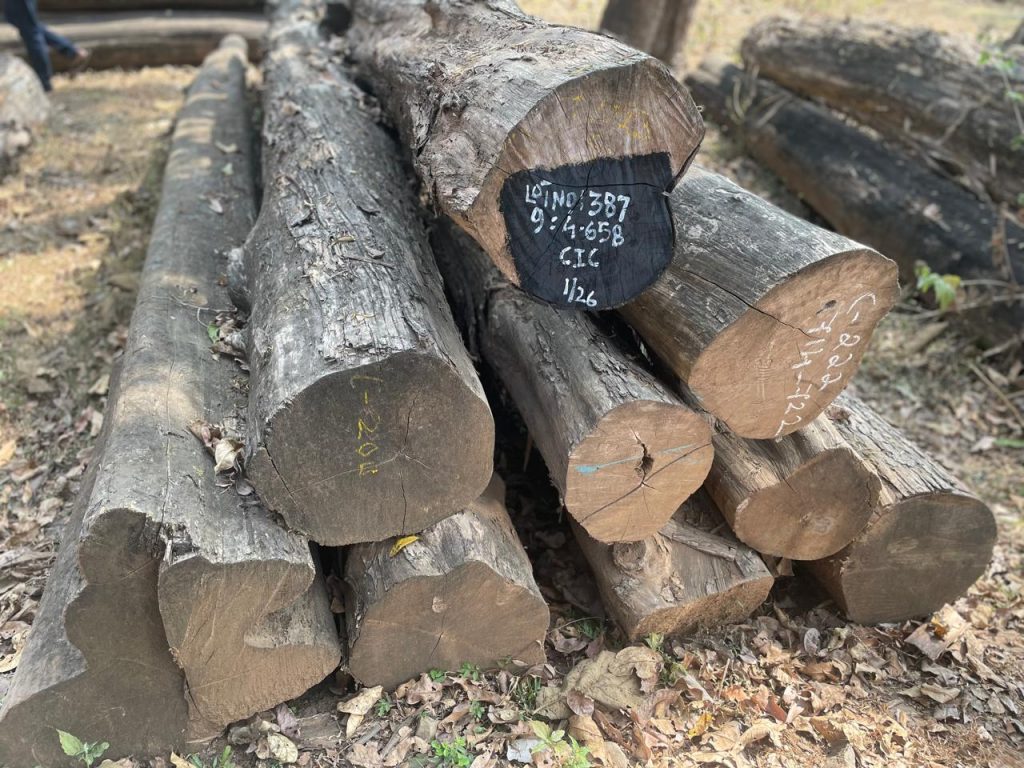
5. Physical Verification Markers
Legitimate timber often bears physical markers:
- – Government hammer marks or stamps on log ends
- – Serial numbers or barcodes
- – Paint markings indicating source depot
- – Measurement marks
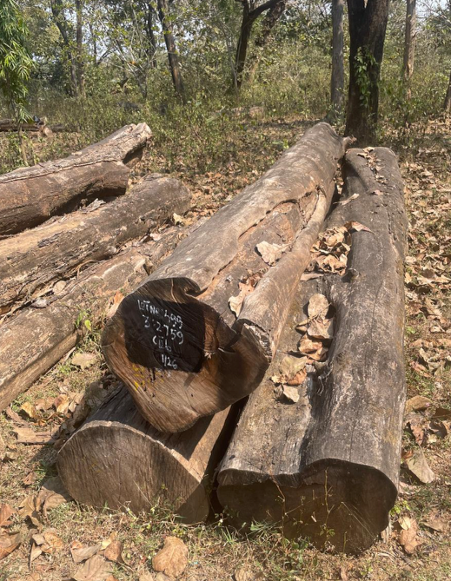
– Lot Number: 499
– Qty: 3.2759M3
– Grading: CIIb
Indian Timber Depot Grading System
The Indian Forest Department, including Karnataka’s depots, uses a grading system adapted to local conditions and market requirements:
Primary Grading Criteria
1. Girth Classification: Indian depots primarily grade by girth (circumference) at breast height:
- – Large Girth: 150 cm and above (premium pricing)
- – Medium Girth: 90-150 cm (standard pricing)
- – Small Girth: Below 90 cm (economy pricing)
2. Length Classification:
- – Long logs: 6 meters and above
- – Medium logs: 3-6 meters
- – Short logs: Below 3 meters
3. Quality Grades:
Grade I (Superior):
- – Straight bole, minimal taper
- – No major defects (heart rot, hollow, deep cracks)
- – Minimal sapwood (less than 20% of cross-section)
- – Sound knots only (small, tight, no rot)
- – Ideal for high-value applications (furniture, veneer)
Grade II (Good):
- – Slight sweep or taper acceptable
- – Minor defects allowed (small cracks, occasional knot)
- – Sapwood up to 30% acceptable
- -Suitable for general woodworking
Grade III (Fair):
- – Moderate defects (bends, multiple knots)
- – Some heart shake or ring shake
- – Sapwood up to 40%
- – Suitable for construction, utility applications
Grade IV (Utility):
- – Significant defects
- – Major cracks, hollow portions
- – High sapwood content
- – Used for low-value applications or firewood
International Teakwood Grading Systems
Myanmar Teak Grading (Traditional Standard)
Myanmar (formerly Burma) has historically set the global standard for teak quality. The Myanmar Timber Enterprise uses a sophisticated grading system:
Grade 1 (Premium):
- Clear wood with minimal defects
- Straight grain, uniform color
- No knots, splits, or sapwood
- Typically from heartwood of mature trees (50+ years)
Grade 2 (Good Quality):
- Minor defects allowed
- Small knots permitted (not through-and-through)
- Minimal sapwood acceptable
- Slight grain variations
Grade 3 (Standard):
- Moderate defects acceptable
- Knots and minor splits allowed
- Some sapwood present
- Suitable for general construction
Grade 4 (Utility):
- Significant defects
- Multiple knots, splits, sapwood
- Suitable for non-structural applications
Reference: Myanmar Timber Enterprise grading standards
Indonesian Grading System
Indonesia uses a simplified A-B-C grading:
Grade A: Premium quality, minimal defects, straight grain Grade B: Good quality with minor imperfections Grade C: Standard quality for general use
General International Quality Indicators
Regardless of source, quality teak exhibits:
- Color: Rich golden-brown to dark brown heartwood
- Grain: Straight and uniform
- Density: 630-720 kg/m³ when air-dried
- Oil content: Natural oils give characteristic feel and aroma
- Durability: Natural resistance to decay and pests
Practical Tips for Buyers
At the Timber Depot or Showroom:
- Request documentation: Always insist on Transit Pass, Sale Certificate, and royalty receipts
- Verify physical marks: Check for government stamps and serial numbers
- Inspect the wood:
- Check end grain for defects, cracks, and heart rot
- Assess sapwood-to-heartwood ratio
- Look for uniformity in color and grain
- Verify measurements: Government depots provide detailed measurements; verify against actual logs
- Ask about source: Reputable dealers can tell you which depot or plantation the wood came from
For Processed Timber:
- Request original documentation: Even for sawn timber, original source documents should be available
- Verify species: Use a wood identification expert if purchasing large quantities
- Moisture content: Use a moisture meter (should be 12-15% for interior applications)
🚩Red Flags to Watch For:
- No documentation – Legitimate teak always has paperwork
- Unusually low prices: If it’s too good to be true, it probably is
- Reluctance to show source: Honest dealers are transparent about sourcing
- Missing physical marks: Government timber always has stamps or markings
- Inconsistent information: Details should match across all documents
- Pressure to buy quickly: Legitimate dealers don’t need to rush you
Verifying the legal sourcing and quality of teakwood requires diligence, but it’s an investment worth making. By insisting on proper documentation, understanding grading systems, and working with reputable dealers, you can ensure that your teak purchase is ethical, legal, and of the quality you expect.
Remember: Quality teak is a long-term investment. Taking the time to verify authenticity and legal sourcing protects not just your purchase, but also our forests for future generations.
At Harsha Timber & Sawmills, we source all our teak exclusively from Government Forest Department depots and sustainable plantations and maintain complete documentation chains for every piece of timber we sell. We encourage our customers to inspect documents, ask questions, and make informed decisions.
Please use the form below to contact us with your Teakwood queries