

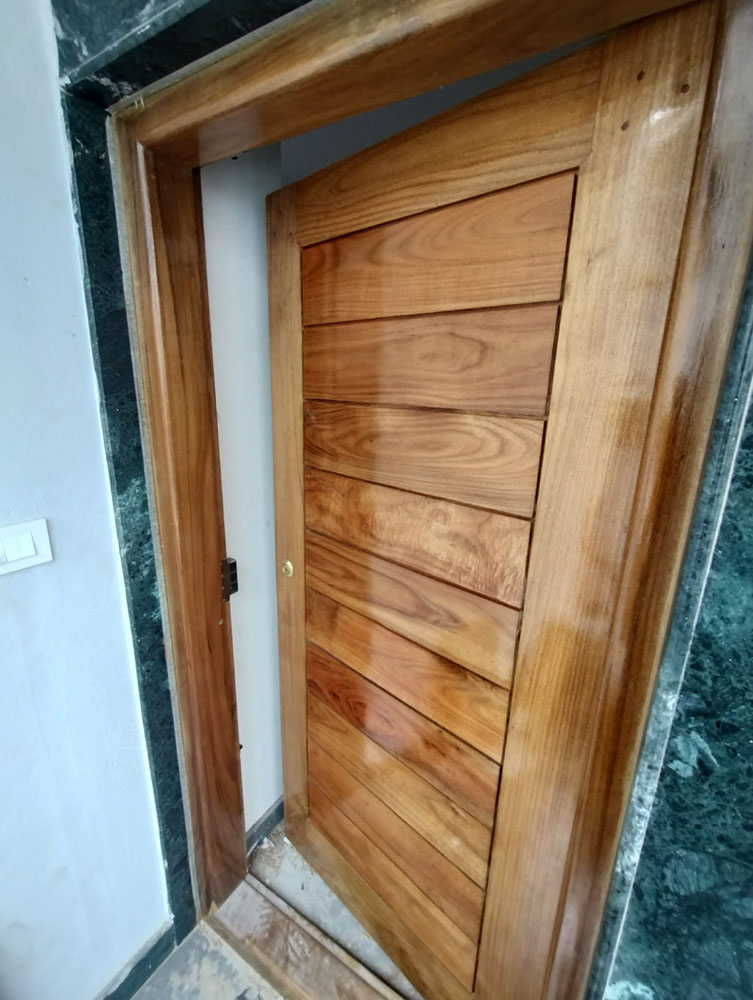
When planning wooden doors for a home, one of the first things to calculate is the timber quantity in cubic feet, or CFT. Harsha Timbers calculates customer requirements in cubic feet and supplies custom cut sections, solid wood doors, frames, and joinery components accordingly, so CFT is the right starting point for budgeting and ordering.
The same basic method works for a main door, pooja room door, internal room door, and bathroom door. You calculate the frame volume, calculate the shutter volume, add them together, and then allow for cutting, joinery, shaping, and fitting losses.
What CFT means?
CFT means cubic feet, which is the standard timber volume unit commonly used for pricing and supply. Harsha Timbers also states that customer requirements are calculated in cubic feet before quotes are given.
How to calculate timber for any door?
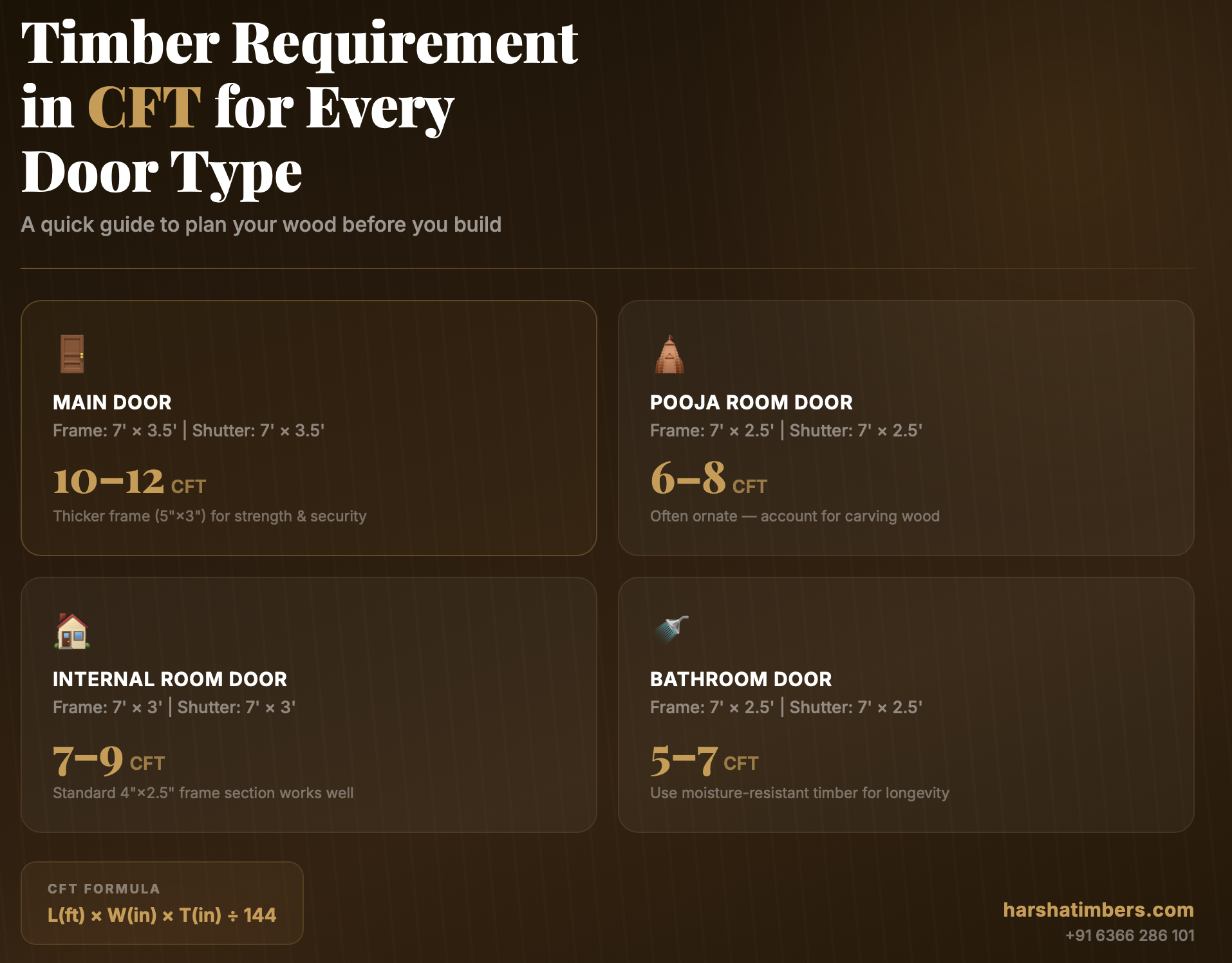
Start by measuring the opening size and then confirm the frame section and shutter thickness. Harsha Timbers lists standard door-frame cut sections such as 75 mm x 125 mm, 75 mm x 100 mm, 62.5 mm x 125 mm, 100 mm x 150 mm, 100 mm x 225 mm, and 75 mm x 275 mm, which helps when selecting an appropriate frame size for each door type.
Use this sequence:
- Measure the door opening.
- Measure the frame section width and thickness.
- Add the running length of all frame members.
- Calculate shutter volume from finished width, height, and thickness.
- Add 5 percent to 10 percent wastage depending on door design and joinery complexity.
For plain internal doors, a lower wastage allowance is usually enough. For main doors and pooja room doors with heavier sections, profiling, carving, or premium joinery, a slightly higher allowance is safer.
Main door calculation
A main door usually has the heaviest sections because it is the primary entrance and must carry more visual weight and durability. Harsha Timbers positions Teak strongly for premium joinery in doors and windows, making it a suitable choice for both the main door frame and shutter.
Sample size used here:
- Opening size: 4 ft x 7 ft.
- Frame section: 5 in x 3 in.
- Frame members: 2 verticals + 1 top + 1 bottom.
- Shutter thickness: 1.5 in.
Frame length = 7 + 7 + 4 + 4 = 22 ft. Frame section in feet = 0.417 ft x 0.25 ft, so frame volume = 22 x 0.417 x 0.25 = 2.29 CFT.
Shutter volume = 4 x 7 x 0.125 = 3.50 CFT. Total timber = 2.29 + 3.50 = 5.79 CFT, and with about 8 percent wastage the practical requirement becomes about 6.25 CFT.
Harsha Timbers also gives a useful benchmark that a standard main door frame of around 1050 mm width comes to about 2.6 cubic feet for the frame alone, which is close to the sample frame estimate above.
Pooja room door calculation
Pooja room doors are usually smaller than main doors, but they often involve a more decorative look with carving, panel work, or grain-focused finishing. Harsha Timbers includes pooja room doors among its solid wood shutter applications, and Teak remains a suitable premium choice for both the frame and shutter in this category.
Sample size used here:
- Opening size: 3 ft x 7 ft.
- Frame section: 4 in x 2.5 in.
- Frame members: 2 verticals + 1 top.
- Shutter thickness: 1 in.
Frame length = 7 + 7 + 3 = 17 ft. Frame section in feet = 0.333 ft x 0.208 ft, so frame volume = about 1.18 CFT.
Shutter volume = 3 x 7 x 0.083 = about 1.75 CFT. Total timber = 1.18 + 1.75 = 2.93 CFT, and with about 8 percent wastage the practical requirement becomes about 3.16 CFT.
Internal room door calculation
Internal room doors, such as bedroom or study doors, can usually use lighter sections than a main door. For this article’s material model, the shutter is taken as Honne and the frame as Mathi, using Harsha Timbers’ species pages and published starting-price references for a more economical indoor combination than full-Teak construction.
Sample size used here:
- Opening size: 3 ft x 7 ft.
- Frame section: 4 in x 2.5 in.
- Frame members: 2 verticals + 1 top.
- Shutter thickness: 1.25 in.
Frame volume remains about 1.18 CFT. Shutter thickness of 1.25 in equals about 0.104 ft, so shutter volume = 3 x 7 x 0.104 = about 2.18 CFT.
Total timber = 1.18 + 2.18 = about 3.36 CFT. With about 5 percent wastage, the practical requirement becomes about 3.53 CFT.
Bathroom door calculation
Bathroom doors usually consume less timber than main or bedroom doors, but finish selection becomes more important because of humidity and repeated wet-dry cycles. Harsha Timbers’ finishes guide explains that protective performance matters alongside appearance, so bathroom doors should be specified with both CFT and finish in mind.
For consistency in this article, the bathroom shutter is budgeted in Honne and the frame in Mathi. That keeps the species selection aligned with the internal-door pricing model while allowing a lower timber budget than Teak.
Sample size used here:
- Opening size: 2.5 ft x 7 ft.
- Frame section: 4 in x 2.5 in.
- Frame members: 2 verticals + 1 top.
- Shutter thickness: 1 in.
Frame length = 7 + 7 + 2.5 = 16.5 ft, so frame volume = 16.5 x 0.333 x 0.208 = about 1.14 CFT. Shutter volume = 2.5 x 7 x 0.083 = about 1.45 CFT.
Total timber = 1.14 + 1.45 = about 2.59 CFT. With around 5 percent to 8 percent wastage, the practical requirement becomes roughly 2.72 to 2.80 CFT.
Door CFT Calculator
Calculate timber requirement in Cubic Feet (CFT) for your door
Approximate timber and Bangalore add-on costs
The table below combines the sample raw timber values with approximate Bangalore add-on costs for seasoning, machining, joinery, carving, sanding, polishing, paint or coating, hardware, transport, installation, taxes, and site adjustments. Raw timber rates are based on published starting prices on our website, while add-on costs reflect Bangalore market references and are best treated as budgeting ranges rather than fixed quotes.
| Door Type | Timber Used | Approx. raw timber value | Seasoning | Machinery & Joinery | Carving | Finish Option |
| Main door | Teak | ₹46,875, using 6.25 CFT and Teak from ₹7,500/CFT | ₹125-₹313, using 6.25 CFT at ₹20-₹50/CFT | ₹4,200-₹5,600, using 28 sq ft at about ₹150-₹200/sq ft | Optional, from about ₹11,200 for full-face carving at ₹400/sq ft | Polish about ₹3,080-₹5,600 at ₹110-₹200/sq ft ; coating about ₹840-₹11,200 depending on system at ₹30-₹400/sq ft |
| Pooja room door | Teak | ₹23,700, using 3.16 CFT and Teak from ₹7,500/CFT | ₹63-₹158, using 3.16 CFT at ₹20-₹50/CFT | ₹3,150-₹5,250, using 21 sq ft at about ₹150-₹250/sq ft | Optional, from about ₹8,400 for full-face carving at ₹400/sq ft | Polish about ₹2,310-₹4,200 at ₹110-₹200/sq ft ; coating about ₹630-₹8,400 depending on system |
| Internal room door | Mathi Frame + Honne Shutter | ₹8,282-₹10,680, using frame 1.18 CFT at ₹2,400/CFT and shutter 2.18 CFT at ₹2,500-₹3,600/CFT | ₹67-₹168, using about 3.36 CFT at ₹20-₹50/CFT | ₹1,995-₹2,520, using 21 sq ft at about ₹95-₹120/sq ft | Usually not taken; custom carving would still start around ₹400/sq ft | Polish about ₹2,310-₹4,200 ; coating about ₹630-₹8,400 depending on system |
| Bathroom door | Mathi Frame + Honne Shutter | ₹6,361-₹7,956, using frame 1.14 CFT at ₹2,400/CFT and shutter 1.45 CFT at ₹2,500-₹3,600/CFT | ₹52-₹130, using about 2.59 CFT at ₹20-₹50/CFT | ₹1,663-₹2,100, using 17.5 sq ft at about ₹95-₹120/sq ft | Usually not taken; custom carving would still start around ₹400/sq ft | Polish about ₹1,925-₹3,500 ; coating about ₹525-₹7,000 depending on system, with moisture-resistant systems being safer for bathrooms |
These are approximate Bangalore costs for budgeting only, and actual pricing will vary by timber quality, door thickness, moisture content, design complexity, finish system, hardware brand, transport distance, and site conditions.
Sanding is often bundled into polishing or coating quotes, while transport is usually billed at actuals and GST is typically applied at 18 percent on the taxable subtotal.
Polish and paint or coating are usually alternative finish systems rather than cumulative charges, so in a real quote you would normally choose one finish route based on the look and protection level you want.
Choosing the right finish
We suggest and highly recommend wood finish as both a protective shield and a style statement, and its finishes guide discusses oil, varnish, lacquer, shellac, wax, and paint as key finish systems. The right finish depends on whether the door is exposed to moisture, sunlight, frequent handling, or mainly serves a decorative indoor role.
Oil finish penetrates the wood and enhances the grain with a warm, natural appearance. Harsha Timbers notes that oil works well for indoor woodwork but has limited moisture resistance and needs regular maintenance, so it is better for protected interior doors than exposed entrances or wet zones.
Varnish forms a tougher protective film and is one of the strongest options for durability, water resistance, and UV resistance. That makes it a strong recommendation for main doors and a sensible option for bathroom doors where protection matters more than a purely natural surface feel.
Lacquer gives a sleek, smooth look and dries quickly, which suits contemporary interiors. Harsha Timbers notes that lacquer is better for interior applications than outdoor exposure because moisture and UV can shorten its life.
Shellac gives timber a warm, classic amber tone and can look excellent on decorative interior doors. Harsha Timbers also notes that shellac is sensitive to water and alcohol, so it is better suited to pooja room and internal room doors than bathroom or exposed entrance doors.
Wax provides a soft sheen and rich touch, but it offers the least protection and needs more upkeep. It is best treated as a decorative interior finish rather than the main protective system for a high-use or moisture-prone door.
Paint offers the highest control over colour and provides strong surface protection, although it hides the natural grain. Harsha Timbers presents paint as a practical finish when uniform appearance and protection are more important than visible wood character.
For a main door, varnish or another strong protective clear coating is usually the safest direction. For a pooja room door, Teak with a clear polished look, oil-based enhancement, shellac-like warmth, or an interior lacquered finish can work well because the grain and detailing remain visible.
For internal room doors, Honne shutters with finishes such as lacquer, oil, shellac, or paint can be selected based on the room style and maintenance preference. For bathroom doors, the finish should prioritize moisture resistance first, so a durable varnish or protective paint system is usually the better choice.
Practical buying tips
Always calculate the frame and shutter separately because they often use different section sizes, thicknesses, and even different species. This becomes even more useful when you are using the mixed-species approach in this article, with Teak for premium doors and Honne-plus-Mathi for internal and bathroom doors.
Confirm whether the frame includes a bottom member before you calculate final CFT. Also confirm whether the shutter is plain, paneled, carved, or profiled, because more detailing usually means more wastage and more finishing work.
Seasoning matters as much as quantity. Harsha Timbers recommends kiln seasoning for cut sections to help reduce warping, cracks, and bending, which is especially important for doors that need stable joinery and long service life.
At Harsha Timbers, we calculate your requirement in cubic feet, recommend a suitable section, and supply made-to-order timber for main doors, pooja room doors, internal room doors, and bathroom doors based on your dimensions, species choice, and finish preference. That makes CFT estimation not just a math exercise, but the basis for choosing the right timber, the right finish, and the right budget from the start. Please use the form below to get an accurate quote for your doors requirement.